


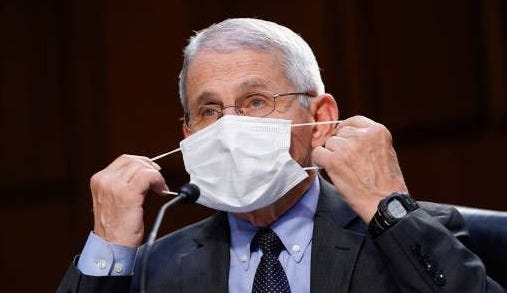
I’ve spent thirty-eight years managing a disease that doesn’t care about my excuses. Type 1 diabetes doesn’t accept “I plead the fifth” as an answer when my blood sugar is 40 and dropping. Every single day, I owe an accounting to my own body, whether I feel like giving one or not. So when I watched Dr. Anthony Fauci sit in front of the Senate Homeland Security and Governmental Affairs Committee on July 29th and invoke his Fifth Amendment right more than a hundred times, something in me that respects accountability just about broke.
The Setup: A Pardon That Wasn’t Enough
Here’s the part that should stop you cold. Joe Biden gave Anthony Fauci a preemptive pardon before leaving office. A pardon. The kind of legal shield most Americans will never be offered in their lifetime, covering him for anything he might have done in his decades running the National Institute of Allergy and Infectious Diseases. And when Senator Rand Paul, the committee chairman and a physician himself, sat Fauci down to finally answer questions about gain-of-function research funding, the lab leak, and his own diary entries, Fauci’s lawyers advised him not to testify at all.
He testified anyway, technically. But for over two hours, according to CNN, Fauci said essentially one sentence, again and again: “Under the advice of my attorneys, I will invoke my right under the Fifth Amendment of the Constitution.”
Let that sink in. A man with a presidential pardon still couldn’t bring himself to answer basic questions about the biggest public health event of our lifetimes, because his own legal team believed his answers, under oath, could still expose him to prosecution for what he might say now. Not for what he did then. For what he might say about it today.
That’s not a man defending his legacy. That’s a man who knows the story doesn’t hold up to direct questions.
Public Service Means Answering For It
I’ve sat on a church finance committee. I’ve run an HR consulting firm that lives and dies by transparency with the businesses I serve. I’ve spent years digging into CYFA’s finances because a youth football organization owes the parents who fund it a straight answer about where the money goes. In every one of those instances, an “I can’t answer that” style answer is treated as exactly what it is: a red flag, not a legal maneuver.
Fauci made his entire career, and his entire public reputation, on the premise that he was the trustworthy expert standing between the American public and a confusing, frightening virus. Taxpayers funded his salary. Taxpayers funded NIAID’s grants, including the ones that went to the Wuhan Institute of Virology. He wasn’t a private citizen protecting trade secrets. He was, by his own account for four decades, a servant of the public interest.
A public servant who spent a career telling Americans to trust the science, trust the experts, trust him, does not get to fold his arms and go silent the one time Congress asks him to explain himself under oath, especially after being handed a pardon that most Americans could only dream of. That’s not humility. That’s a calculated bet that silence is safer than the truth.
This Isn’t New. I Called It Years Ago.
Regular readers know I was skeptical of the official COVID narrative from very early on, and not because I distrust science. I trust it enough to understand the concept of trial and error to keep myself alive and healthy. I was skeptical because the story kept changing while the certainty never did.
Masks don’t work, then masks are mandatory.
The virus definitely didn’t come from a lab, until suddenly the lab leak theory was plausible after all.
Natural immunity from prior infection was waved away for two years while public health officials pretended vaccination was the only path that counted, a position that never made biological sense and that I said so at the time.
I read Robert F. Kennedy Jr.’s “The Real Anthony Fauci” when it came out, and I’ll say plainly what a lot of people were afraid to say in 2021: the pattern the book lays out, of a career bureaucrat consolidating unprecedented authority over American life, sidelining dissenting scientists, and blurring the line between public health guidance and enforced ideology, tracked with what I was watching happen in real time in my own community. Churches closed. Small businesses in shuttered while big box stores stayed open. Kids lost a year and a half of development over a virus that, for most children, posed less risk than the flu.
Then Senator Paul’s book “Deception: The Great Covid Cover-Up” laid out, with the receipts, exactly what a lot of us suspected but couldn’t prove without subpoena power: that the gain-of-function research funded in part by American tax dollars was a live possibility for the virus’s origin from the very beginning, that officials understood this early, and that the effort to shut down that conversation wasn’t about protecting public health. It was about protecting reputations and research dollars. Paul makes the case that the real damage wasn’t the virus. It was the cover-up. I agree with him 100%… but what was covered up will likely always remain a mystery.
“Trust Me” Isn’t a Policy
I don’t think Fauci’s use of the Fifth Amendment proves criminal guilt. That’s not how the Fifth works, and any honest person has to acknowledge that. The privilege against self-incrimination exists for good reason, and I’d defend it for anyone else in his position too, including people I disagree with.
But there’s a difference between a constitutional right and a moral obligation. Fauci had the legal right to go silent. He did not have the moral standing to do it and still call himself a public servant. You don’t get to spend a career demanding the public’s total, unquestioning trust and then, the one time someone hands you a subpoena and a pardon in the same breath, decide that transparency is suddenly too risky.
I manage a chronic disease that punishes deflection immediately and mercilessly. I don’t get a Fifth Amendment with my pancreas. Neither should the people we pay to run our public health institutions get one with the public they served, especially after they’ve already been forgiven in advance for whatever they might have done.
Senator Paul says he’ll push for a contempt vote. Whether that goes anywhere is a legal question for people smarter than me on procedure. But the political and moral question isn’t complicated at all. When the man who told an entire country to trust the science won’t answer a single question about how that science was managed, the rest of us are entitled to draw our own conclusions.
My unCommon Sense
Public trust isn’t a blank check. It’s a loan, and it comes due. Fauci spent four years asking Americans to hand over their businesses, their kids’ educations, and their personal medical decisions on the strength of his authority alone. When the bill for that trust finally came due in a Senate hearing room, he had his lawyers write the check in silence instead. A pardon should have freed him to tell the whole story without fear. Instead, it revealed that even total legal immunity for the past wasn’t enough to get the truth out of him about the present. That tells you everything you need to know about how much of the official COVID story was ever built to survive daylight.
If you want to have a constructive conversation about this or anything else, message me at dan@thrailkill.us, and let’s grab coffee or a beer.
Have a good one,
Dan