


I have been living with Type 1 diabetes since January 13, 1988. I was 7 years old. My grandfather, Dr. James C. Thrailkill, diagnosed me over the phone. That was 38 years ago, and I am still here, still testing, still managing, still fighting natural selection on a daily basis.
So when the editors of Diabetes Care publish an editorial with a title like “Misguided Brushes of a Pen Continue to Dismantle and Destroy Biomedical Research in the United States,” you can bet I read it. Every word.
Drs. Steven Kahn, Cheryl Anderson, John Buse, and Elizabeth Selvin are serious people. They are not cranks. Their June 2026 editorial in Diabetes Care [1] documents an 89% reduction in Notices of Funding Opportunities, a 66% reduction in grant awards, advisory councils operating at one-third capacity, political appointees replacing scientific experts, and a “multiyear forward funding” policy that effectively depletes future research dollars while making current spending look normal.
Then the story got stranger.
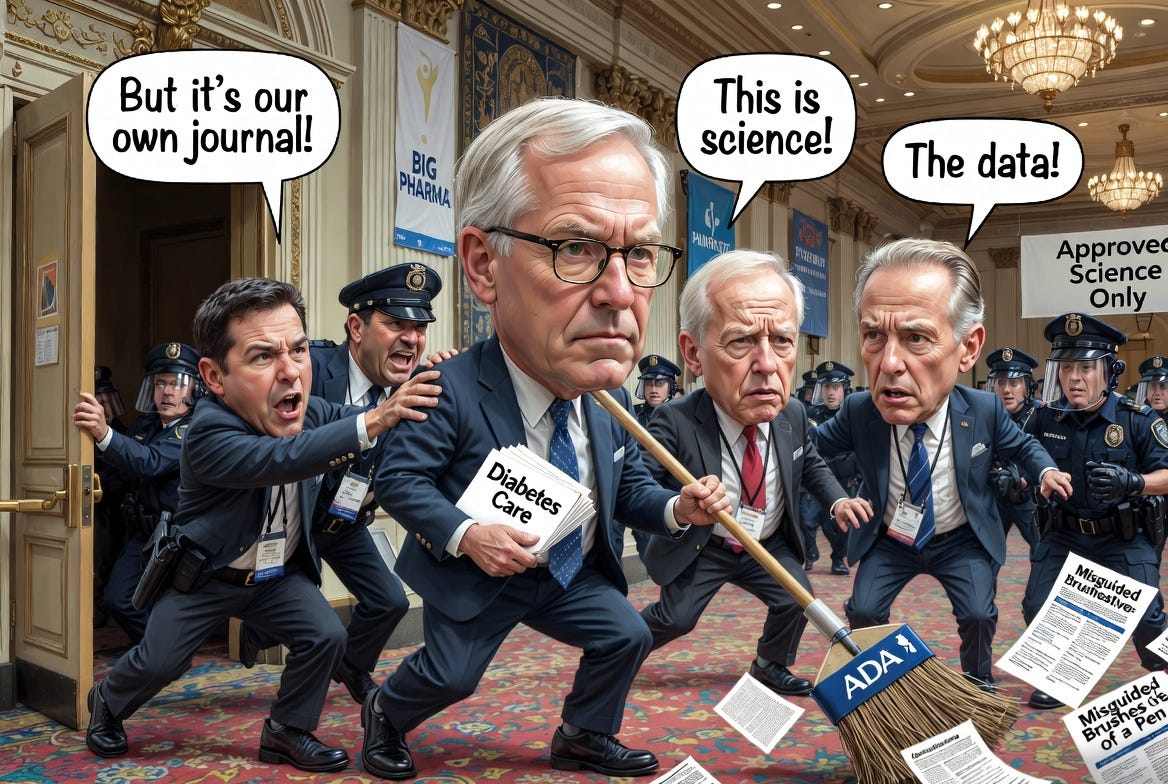
On June 5, 2026, Dr. Kahn flew to New Orleans to present at the American Diabetes Association’s annual scientific sessions. Instead of presenting, he and four colleagues were physically removed from the convention center by police while handing out printed copies of that editorial to fellow researchers. Video captured an officer chest-bumping Dr. Aaron Kelly, a professor of pediatrics at the University of Minnesota. The ADA banned all five from the remainder of the conference and warned them they would be arrested if they returned [16]. NIH director Jay Bhattacharya pulled out of his scheduled keynote at the last minute.
The ADA cited a “code of conduct violation.” Dr. Kahn called it a serious mistake. He was right on both counts, and I will get to why.
Those funding numbers are real. I am not dismissing them. But the editorial, and the spectacle that followed it, both rest on an assumption neither ever examines: that the federal government was the right institution to be funding most of this research in the first place, and that the current system, government funding, private profit, nonprofit intermediaries, is actually serving patients well. I have lived with this disease for thirty-eight years and used nearly every major technology to come out of it. My view is more complicated than that.
The Honest History of What I Use Every Day
Let me walk through the major tools I use (and have used) to manage my diabetes. Where did this stuff actually come from?
Insulin itself. Discovered in 1921 at the University of Toronto, university science. For sixty years after that, diabetics used animal-derived insulin. I was diagnosed on it. The modern insulin story then follows a clear pattern: Boyer at UCSF and Cohen at Stanford developed recombinant DNA technology at university labs in 1973 [2], venture capital immediately moved in, Genentech synthesized recombinant human insulin, Eli Lilly licensed and scaled it, and the FDA approved Humulin in 1982 [3]. Academic foundation, private execution.
Humalog and Novolog. Both rapid-acting insulins developed entirely inside private labs — Eli Lilly for Humalog in 1996, Novo Nordisk for Novolog in 2000 [4, 5]. No NIH grant in either development chain.
Tresiba. The ultra-long-acting basal insulin I currently use, discovered, developed, and funded entirely by Novo Nordisk [6]. FDA approved in 2015. Not a federal dollar in the development chain.
The blood glucose meter. In 1965, Ames Company, a private industrial lab in Indiana, developed the Dextrostix, the first blood glucose test strip [7]. Five years later, Anton H. Clemens, a German-born electrical engineer serving as Director of R&D at Ames, invented the first blood glucose meter by building a reflectance photometer to read the strip quantitatively [8]. Patented in 1971. Three pounds, $650. A private company’s engineer solving a problem he identified himself. No NIH grant, no federal research program. By the time I was diagnosed in 1988, meters had shrunk to something pocket-sized — entirely the product of private competition.
The CGM currently implanted in my arm. I have worn Dexcom G4s, G5s, G6s, and Abbott FreeStyle Libres. What I use now is the Eversense 365 from Senseonics — a fully implanted sensor lasting a full year. The conceptual roots trace to Leland Clark Jr.’s 1962 university research [9], but the technology sat in journals for three decades. Commercial CGMs came from private startups. Dexcom alone spent $552 million on R&D in 2024 [10]. The Eversense was seeded from 2000 to 2003 by the JDRF (now called Breakthrough T1D.. WTF!), a patient advocacy nonprofit [11], then commercialized by Senseonics. The federal government’s role: regulatory gatekeeper. The global CGM market is projected to reach $47 billion by 2034 [12].
Insulin pumps. I wore a pump for twenty years. The first portable pump was built by Dr. Arnold Kadish at Loma Linda University in 1963. Then in 1973, Dean Kamen, a college student working without federal grants, built the first wearable infusion pump at home and went on to found AutoSyringe, Inc. [13]. MiniMed introduced the first commercial pump in 1983. Every closed-loop system that followed, Control-IQ, Omnipod 5, twiist AID, came from private investment and engineering competition.
The pattern is consistent across every technology. Academic or private-engineer insight provided the spark. Private capital built the product. Patient advocacy nonprofits sometimes filled early funding gaps. The federal government approved, regulated, and occasionally funded studies nobody had commercial incentive to run. That last category matters. But it is a narrow lane — and the system built around it is messier than the Kahn editorial lets on.
The Three-Way Entanglement Nobody Wants to Talk About
When NIH funds basic research at a university and a private company commercializes that discovery, the government retains essentially no financial return. The Bayh-Dole Act of 1980 gives universities the right to patent inventions from federally funded research and license them exclusively to private companies [17]. The company gets the patent rights. The company prices the product. The taxpayer who funded the underlying research gets nothing back, not a royalty, not a price control, not a licensing fee.
The NIH has “march-in rights” under Bayh-Dole that theoretically allow it to override a license if a product is not reasonably accessible. In practice these have never been used for drug pricing. When a nonprofit petitioned NIH in 2004 arguing that Abbott and Pfizer were overcharging consumers for drugs developed using government funding, NIH explicitly rejected the idea that Bayh-Dole was a tool for policing pharmaceutical prices [18]. Taxpayers funded the science. Companies set the price. The government said that is not our problem.
You want to talk about one of the reasons why insulin is expensive? That is a part of the answer.
Now add the nonprofits. Breakthrough T1D, formerly JDRF, an organization I have been affiliated with since its Palmetto Chapter was cofounded by my family, has done important work. But Breakthrough T1D today operates an Industry Advisory Panel as a formal relationship-building forum with the pharmaceutical and device companies whose products its community uses [19]. It runs a program that explicitly funds for-profit companies doing research aligned with its priorities [20]. It operates a venture philanthropy fund, the T1D Fund, that makes direct equity investments in companies developing T1D treatments, with the stated goal of reinvesting any gains into more investments [21].
Breakthrough T1D takes donations from T1Ds and their families, uses some of that money to seed companies, those companies develop products, and those products get sold back to T1Ds at market prices, while Breakthrough T1D maintains formal advisory relationships with those same companies. Disclosure is not resolution. The organization’s own UK website states its industry partnerships “in no way impacts or influences our strategic direction” [22]. Maybe so. That is also exactly what you would expect them to say.
Then ask the question nobody in this ecosystem wants to answer out loud: is a cure actually in anyone’s financial interest?
The global diabetes treatment and devices market was valued at roughly $150 billion in 2024 and is projected to approach $250 billion by the end of the decade [23]. That is a market built on managing a chronic condition indefinitely, selling insulin, sensors, pumps, and drugs to the same patients, year after year, for life. Treatment is a revenue stream. A cure is a one-time event that ends it. Every company in this space, the ones Breakthrough T1D partners with, the ones NIH-funded researchers license their discoveries to, the ones whose products keep me alive, profits more from my continued condition than from its resolution. That is not an accusation. It is arithmetic.
Government funds the research at taxpayer expense. Private companies commercialize it for profit with no revenue back to taxpayers. Nonprofits develop financial relationships with those same companies, complicating their ability to advocate for lower prices or independent research. The patient donates to the nonprofits, pays for the products, and is asked to be grateful the system produced them. This is not a conspiracy. It is how the incentives were designed, and it is worth naming clearly.
What the Government Actually Did Well
The DCCT/EDIC study, which ran for decades and established the glycemic control standards governing T1D management today, is a genuine example of research the private sector would not have funded. Generic insulin regimens, thousands of patients, no product at the end. The teplizumab story is another: out of the NIH-funded TrialNet consortium came the discovery that an anti-CD3 antibody could delay progression to clinical Type 1 diabetes [14]. Federal money, meaningful result.
Those examples are legitimate. They are also a small slice of a $47.5 billion annual enterprise.
The Conflict of Interest Hiding in Plain Sight
The editorial discloses it in the footnotes: all four authors hold NIH grants and have a direct financial stake in NIH funding levels. That does not make them wrong, but their alarm deserves the same scrutiny we apply to any interested party advocating for their own continued funding. Recognizing that is not cynicism. It is just paying attention.
What Actually Worries Me
The politicization of scientific peer review is the first concern. Advisory councils stacked with political appointees, grant approvals routed through HHS for ideological alignment. As Francis Collins said recently: “Mix politics and science, you get politics. You kind of lose everything else.” [15] Scientific credibility, once spent on patronage, does not come back quickly.
The 89% reduction in Notices of Funding Opportunities is the second — not primarily because it cuts dollars, but because it shuts down the system that identified research gaps the market has no incentive to map. That specific function has value private R&D does not replicate.
The New Orleans incident adds a third concern entirely separate from NIH funding. The ADA, whose mission is the health of people with diabetes, had its own editor-in-chief removed from its conference by police for handing out a peer-reviewed editorial [16]. The ADA then emailed Dr. Kahn: “We appreciate the years of service and leadership you have provided to the ADA, and we regret that it came to this.”
They regret it came to this. But they did it anyway. That is institutional cowardice with a coat of procedural polish, and it happened entirely outside the government. The ADA made that call on its own, under political pressure, to protect its relationship with an administration. The threat to scientific discourse does not require a government actor - organizations built to serve patients will suppress inconvenient speech when the pressure is sufficient. Keep that in mind the next time a patient advocacy organization tells you its industry partnerships in no way influence its strategic direction.
MY unCOMMON SENSE
Government does not produce economic output. It redistributes it. When the government funds research, it takes money from people who earned it and directs it toward priorities chosen by people who did not. That transaction needs a strong justification, not a default assumption that more federal spending produces more benefit for patients.
Thirty-eight years of this disease has given me a clear-eyed view of where the innovations actually came from. The meter I test with, the CGM in my arm, the twenty years I spent on a pump, the insulins I inject, all of it came primarily from companies competing for my business, built on academic foundations, occasionally seeded by advocacy organizations whose independence from industry is worth scrutinizing. The narrow lane of government research, long-duration studies, generic drug trials, foundational science nobody can patent but everybody builds on, deserves continued support. But it is a fraction of what the NIH currently does.
The federal government expanded aggressively into biomedical research over decades, creating a pipeline of public-funded discoveries, private profits, nonprofit entanglements, and taxpayers who get no return on the front end while paying market prices at the back end. A correction was probably coming regardless of who was in the White House. The way it is happening, through political patronage, ideological grant screening, and institutional intimidation, is a bad method. I will not defend it.
But the direction? Pulling federal involvement back to the narrow lane where it adds real value, and forcing a harder look at who actually benefits from the rest?
That conversation is overdue. The editorial that got Dr. Kahn removed from a conference did not start it. Maybe his removal will.
If you want to have a constructive conversation about this or anything else, message me at dan@thrailkill.us, and let’s grab coffee or a beer.
Have a good one,
Dan
References
Kahn SE, Anderson CAM, Buse JB, Selvin E. Misguided Brushes of a Pen Continue to Dismantle and Destroy Biomedical Research in the United States: We Can No Longer Afford Complacency and Fear. We Must All Act Now! Diabetes Care. 2026;49:901–905. https://doi.org/10.2337/dci26-0068
National Academies of Sciences. Incentives and Focus in University and Industrial Research: The Case of Synthetic Insulin. In: Sources of Medical Technology: Universities and Industry. Washington, DC: National Academies Press; 1995. https://www.ncbi.nlm.nih.gov/books/NBK232052/
National Museum of American History, Smithsonian Institution. Recombinant Drugs: Humulin. https://americanhistory.si.edu/collections/object-groups/birth-of-biotech/recombinant-drugs
ScienceDirect. Insulin Lispro — Overview. https://www.sciencedirect.com/topics/medicine-and-dentistry/insulin-lispro
Frontiers in Endocrinology. Impact of Structure and Formulation Changes on the Function of Insulin Products. 2025. https://www.frontiersin.org/journals/endocrinology/articles/10.3389/fendo.2025.1601119/full
Endocrine Reviews. Evolution of Insulin and How it Informs Therapy and Treatment Choices. 2020;41(5):733. https://academic.oup.com/edrv/article/41/5/733/5836295
History and Evolution of Capillary Glucose Monitoring. International Journal of Diabetes and Technology. 2023. https://journals.lww.com/ijdt/fulltext/2023/02020/history_and_evolution_of_capillary_glucose.1.aspx
Mystrategist.com. In MedTech History: Blood Glucose Monitoring — The Ames Reflectance Meter. https://www.mystrategist.com/blog/article/in_medtech_history_blood_glucose_monitoring.html
Didyuk O, Econom N, Guardia A, Livingston K, Klueh U. Continuous Glucose Monitoring Devices: Past, Present, and Future Focus on the History and Evolution of Technological Innovation. Journal of Diabetes Science and Technology. 2021. https://pmc.ncbi.nlm.nih.gov/articles/PMC8120065/
Dexcom, Inc. Fourth Quarter and Fiscal Year 2024 Financial Results. February 13, 2025. https://investors.dexcom.com/news/news-details/2025/Dexcom-Reports-Fourth-Quarter-and-Fiscal-Year-2024-Financial-Results/default.aspx
Breakthrough T1D. FDA Approves Eversense CGM for Use Up to 6 Months. https://www.breakthrought1d.org/news-and-updates/fda-approval-senseonics-eversense-cgm-use-up-6-months/
Global Market Insights. Diabetes Care Devices Market Outlook 2025–2034. https://www.gminsights.com/industry-analysis/diabetes-care-devices-market
National Inventors Hall of Fame. Dean Kamen — AutoSyringe. https://www.invent.org/inductees/dean-kamen
Herold KC, Bundy BN, Long SA, et al.; Type 1 Diabetes TrialNet Study Group. An anti-CD3 antibody, teplizumab, in relatives at risk for type 1 diabetes. N Engl J Med. 2019;381:603–613.
Park A. Dr. Francis Collins led the NIH. Now, he fears for the future of science. Time. March 20, 2026. https://time.com/7269521/nih-dr-francis-collins-future-of-science
Greenberg SH. Police Remove Researchers From Diabetes Conference. Inside Higher Ed. June 8, 2026. https://www.insidehighered.com/news/quick-takes/2026/06/08/police-remove-diabetes-researchers-conference
Patent and Trademark Law Amendments Act of 1980 (Bayh-Dole Act), Pub. L. No. 96-517, 35 U.S.C. §§ 200–212. https://www.govinfo.gov/content/pkg/STATUTE-94/pdf/STATUTE-94-Pg3015.pdf
Hutchinson Law Group. Government-Funded Inventions: Licensing Guide — March-In Rights and Pricing. https://www.hutchlaw.com/library/do-i-need-to-care-that-the-invention-my-company-is-licensing-was-funded-by-the-government
Breakthrough T1D. Corporate Partnerships — Industry Advisory Panel. https://www.breakthrought1d.org/about/corporate-partnerships/
Breakthrough T1D. Industry Discovery and Development Partnership Program. https://grantcenter.jdrf.org/industry-partnerships/
T1D Fund (Breakthrough T1D Venture). About the JDRF T1D Fund. https://t1dfund.org/news/diasome-pharmaceuticals-inc-receives-funding-from-jdrf-t1d-fund/
Breakthrough T1D UK. Working with Industry Partners. https://breakthrought1d.org.uk/how-to-help/corporate-partners-and-sponsors/working-with-industry-partners/
BCC Research. Global Diabetes Therapeutics and Diagnostics Markets, 2025–2030. October 2024. https://www.bccresearch.com/market-research/healthcare/diabetes-therapeutics-diagnostics-markets-report.html